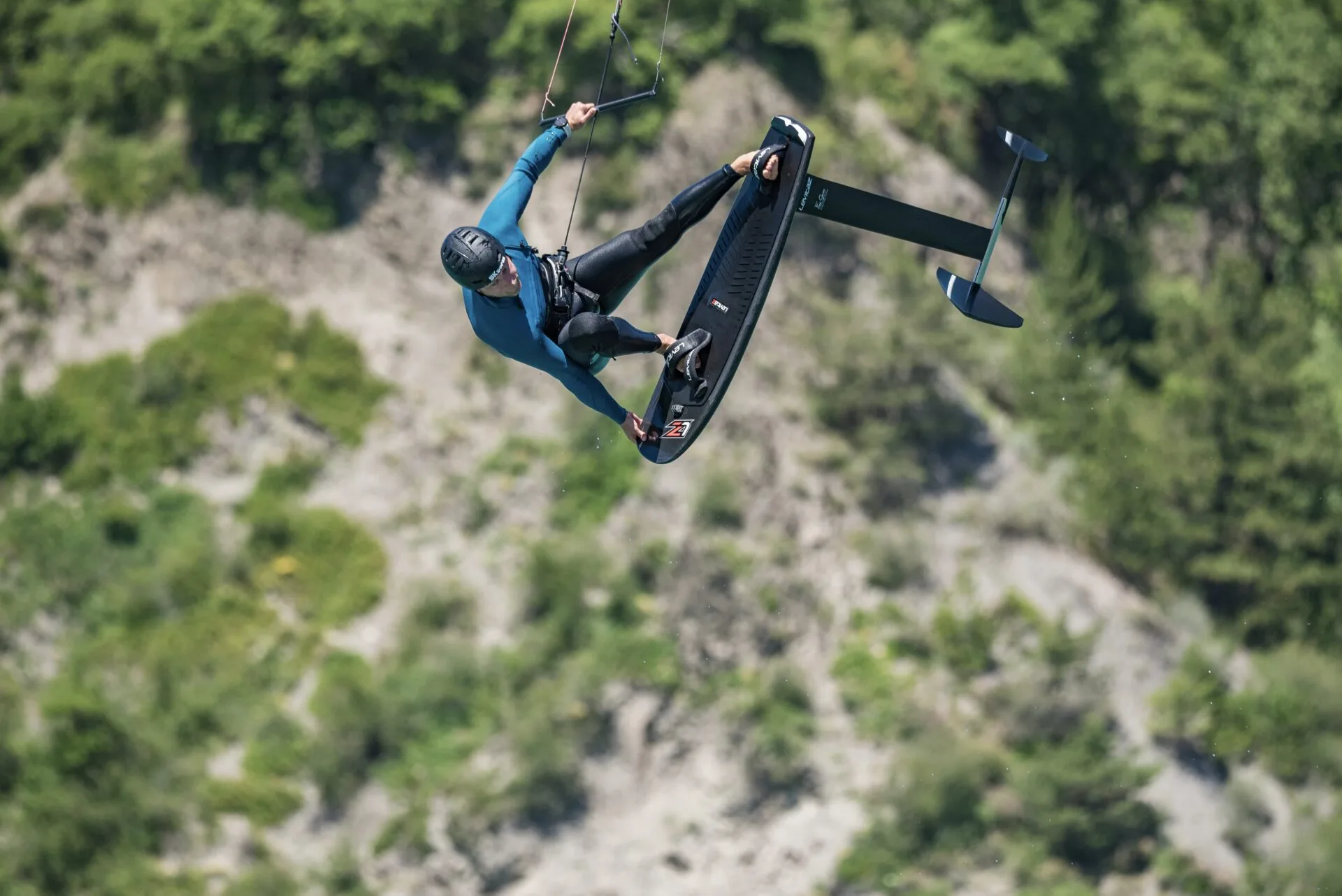
Levitaz Free Series: Feedback, Explanation, and Recommendations
With the Free Series, Levitaz is launching a new era of hydrofoils. Levitaz has been developing and producing race hydrofoils for a decade, and the immense knowledge and know-how from that sector helped them immensely in designing the Free Series. While a freeride foil doesn’t necessarily need to win a race, it still needs a wide speed range, exceptional stiffness, and ease of use. These factors are actually just as important in racing; athletes have so much to focus on that they simply can’t afford to ride a difficult foil.
When I tested the pre-production models of the Free Series, I immediately recognized how easy these foils are to ride and how quick they are, while remaining incredibly stable at riding speeds under 20 km/h.
Spoiler Alert: I rode race foils for 10 years, and they were my weapon of choice for freeriding, jumping, and speed runs. But after testing the Free Series for just two sessions, I never went back to my race foil—there was simply no benefit for me anymore. Despite the tiny bit of extra top speed I could probably squeeze out of a race foil, absolutely everything else was easier and more fun on the Free Series. I learned a new trick in almost every session and found myself developing a new riding style that is much more playful, yet still powerful and performance-oriented.
Why is the Levitaz Free Series Different?
It all comes down to engineering and simplicity. When it comes to design, there is a saying: Keep it simple, stupid. Overengineering makes gear less accessible and, most of the time, unnecessarily expensive.
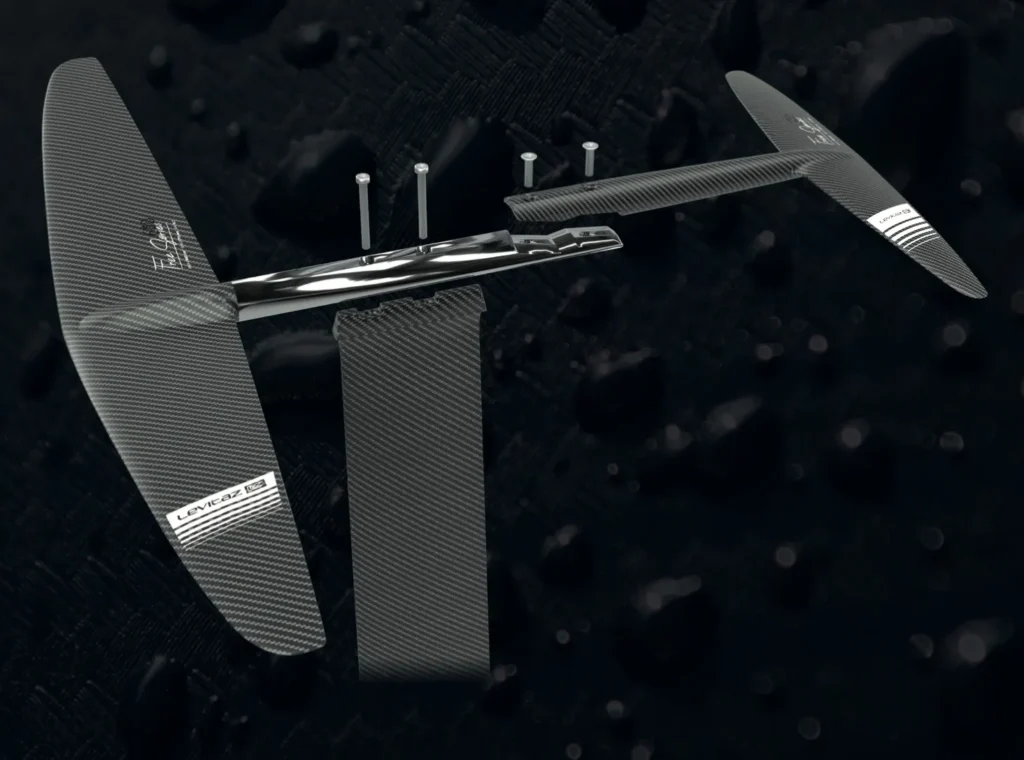
- Direct Connection: The heart of the Free Series is the titanium fuselage. The carbon front wing is laminated directly to the fuselage, creating the most direct connection possible. You don’t need any additional parts or screws to attach the front wing.
- Smart Mast Integration: The mast-to-fuselage connection is brilliantly simple. You just slide the bottom of the mast into the CNC-machined cavity of the fuselage and secure it with two screws.
- Fail-Proof Back Wing: The back wing screws onto the fuselage with two screws, and the threads for this connection are tapped directly into the titanium. This means there are no metal threaded inserts laminated into carbon parts—which are prone to failing and impossible to repair.
- One Tool Fits All: The pinnacle of simplicity for the rider is that all three connections (Mast-to-Board, Fuselage-to-Mast, Back Wing-to-Fuselage) can be tightened with the exact same tool (Torx T30). Even better, they are all accessed from the same side, so you never have to flip the foil over to tighten different screws.
Why a Titanium Fuselage?
Titanium offers the absolute best ratio of weight, strength, and corrosion resistance. To avoid wear at the highly precise mast-connection cavity, a strong material is mandatory. While some brands use a carbon-to-carbon connection, this can cause wear over time, resulting in unwanted play. This happens because a hydrofoil fuselage must endure extreme, multi-directional (multiaxial) forces concentrated in a very small, non-directional area. Carbon fiber is incredibly strong along its fibers, but it struggles with these chaotic local loads. To compensate for this weakness and handle the stress, carbon fuselages must be built significantly thicker and bulkier, which adds unwanted drag. Titanium, on the other hand, handles these multi-directional forces effortlessly while maintaining an ultra-slim profile.
Stainless steel is about 75% heavier than titanium and can cause galvanic corrosion when combined with carbon composites. Aluminum is about 40% lighter than titanium, but it isn’t as strong, and its corrosion resistance in saltwater is terrible.
Front Wing Lineup & Recommendations
Compared to other foil manufacturers, the Free Series lineup is beautifully compact, yet it covers a massive range of disciplines and riding styles. This makes choosing your configuration much easier and keeps your quiver simple and curated. The four front wings aren’t just scaled-up versions of one another; each was designed separately and fine-tuned for its specific target group.
| Front Wing | Surface Area | Span | Aspect Ratio | Best For |
|---|---|---|---|---|
| FW 540 | 540 cm² | 67 cm | 8.4 | Freeracing, Strong Winds, Big Air, Freestyle |
| FW 680 | 680 cm² | 77 cm | 8.7 | The versatile “Swiss Army Knife”, All-Around Kitefoil |
| FW 790 | 790 cm² | 90 cm | 10.3 | Wingfoiling, Parawinging, Heavy and Beginner Kitefoilers |
| FW 900 | 900 cm² | 110 cm | 13.3 | Endless Glide, Light Wind Winging, Downwinders |
FW 540
This front wing was designed for freeracing, strong winds, big air, and freestyle. The wing generates lift quite early and is playful and forgiving.
- My Experience: I personally use it mainly for kitefoiling to jump high and do speed runs in 12–30 knots. Top speeds of up to 60 km/h are absolutely possible, but I also use it when I want a playful setup riding with straps or strapless.
FW 680
The FW 680 is the most versatile front wing in the lineup. It is the Swiss Army Knife, created for all-around kitefoiling, wingfoiling in stronger winds (>20 knots) for lighter riders (<75kg), and freestyle maneuvers. Its low stall speed and great stability make it perfect for practicing sit-down tricks.
- My Experience: I use this front wing for 95% of my kitefoiling sessions because it can do it all. I weigh around 70kg, and my speed range with this wing is 15 km/h to 58 km/h. Back when I used a full competition race foil, I rarely used a kite smaller than 15m². Now, my biggest kite is a 12m², and in consistent 5-knot winds, I can comfortably ride, tack, and jibe. I recommend this as a beginner foil if you weigh under 75kg.
FW 790
The FW 790 is, in my opinion, the most versatile front wing for wingfoiling. It has a low takeoff speed, remains highly agile, and boasts a great top speed. It is also an excellent choice for parawinging, whether you are freeriding or going for a long downwind run.
- My Experience: As an advanced wingfoiler, I easily hit 45 km/h on this wing in 20 knots of wind. For kitefoiling, this is an absolute cheat code for learning tacks and jibes. I highly recommend it for beginners, heavier riders, or anyone who loves riding small kites (<12m²) in sub-10 knot winds.
FW 900
If you are looking for the most efficient wing with endless glide, this is it! Designed for wingfoiling and parawinging, this wing is pure joy for downwinders or surfing small waves in moderate wind. Riders over 80kg should choose this wing for wingfoiling instead of the FW 790.
- My Experience: At 70kg, I use this wing for light-wind winging (8–15 knots), downwinders, or playing around in waves up to 1 meter.
The Back Wing: One Size Fits All
To keep things as simple as possible for the rider, there is only one back wing available for the Free Series: the BW 180 (Surface Area: 180 cm², Span: 39 cm, Aspect Ratio: 8.6).
The riding behavior of the BW 180 is incredibly balanced and pitch-stable. It is easy to ride and provides so much comfort that you can fully trust your setup and push the hydrofoil to its absolute limits.
Mast Selection Guide
Choosing the right mast height and profile is critical to matching your local conditions and riding style.
| Mast Model | Length | Min. Thickness | Discipline Focus |
|---|---|---|---|
| M 76 | 76 cm | 16.0 mm | Downwind, Shallow Water, Pumping |
| M 84 | 84 cm | 14.5 mm | All-around Wingfoiling and Kitefoiling |
| M 96 | 96 cm | 13.9 mm | Performance and Freeride Kitefoiling |
M 76
Developed primarily for downwind disciplines, this short mast is also perfect for wing and kitefoiling in shallow spots. The shorter length makes the ride incredibly playful and direct. Thanks to its relatively thick 16mm profile, this mast is extremely stiff, transferring energy efficiently from your body into the foil. This is a massive benefit when pumping into a wave or connecting swells.
M 84
This mast does everything brilliantly. Designed for wingfoiling, it is also a fantastic choice for kitefoiling. For wingfoiling, I always use this mast because it strikes the perfect balance between playfulness and forgiveness. If you do both sports, this is the mast for you.
M 96
This long mast is ideal for kitefoiling. The extra length provides clearance and forgiveness in wavy conditions and supreme stability at high speeds. When heeling the board over to ride upwind, the extra length prevents the wingtips from breaching too early. At only 13.9mm thick, this is the thinnest mast in the lineup, producing the lowest drag for performance-oriented top speeds and steep upwind/downwind angles.
Ready to build your perfect setup?
I hope this guide helps you choose the perfect Levitaz Free Series hydrofoil for your riding style. You can configure your setup directly in our Hydrofoil Configurator.
If you still have questions or would like a personal consultation, please don’t hesitate to contact us!